NFL Player Prop Bets in the UK: A Position-by-Position Breakdown
 Available in US
Table of Contents
- What Separates Player Props From Team and Game Markets
- Quarterback Markets: Passing Yards, TDs and Interceptions
- Running Back Markets: Rushing Yards and Anytime TDs
- Wide Receiver and Tight End Markets: Receptions and Yards
- Defensive Player and Kicker Props
- Head-to-Head Player Matchup Props
- Reading a Player Prop Line at a UK Sportsbook
- Where Statistical Value Hides in Player Props
- Frequently Asked Questions

What Separates Player Props From Team and Game Markets
I placed my first player prop on a Thursday night game in 2017 — Patrick Mahomes passing yards, back when half the UK punters I knew had never heard of the market. The line was soft, the bookmaker clearly hadn’t adjusted for his arm talent, and the over cashed before the fourth quarter. That single bet changed how I thought about NFL wagering, because it forced me to study one athlete rather than predict the outcome of an entire contest.
That distinction matters. When you bet a point spread or a match result, you’re forecasting a collision between two full rosters, two coaching staffs and a dozen situational variables. A player prop strips that complexity down to a single question: will this individual exceed a statistical threshold? The anytime touchdown scorer market — the single most popular player prop by handle at major sportsbooks — is a perfect example. You don’t need to know who wins. You need to know who reaches the end zone.
Prop bets can account for 15-20% of the total NFL handle at online bookmakers, and the hold percentage the book retains on those markets tends to be higher than on sides and totals. That extra margin is why understanding player props deeply, rather than dabbling in them, gives you a genuine informational edge. Team and game props ask broader questions — will the combined score go over 47.5, will Team A score first? Player props zoom in on individual output: yards, touchdowns, receptions, completions, sacks. The data you need is narrower, more accessible, and often more predictive than the data required for game-level markets.
This guide breaks the player prop menu at UK bookmakers into positions, explains how lines form for each, and shows where the pricing gaps tend to sit. The focus is on individual performance markets — the bets tied to what a specific player does on the field, rather than match outcomes or team totals.
Learn more about prop bets for nfl on our main page.
Quarterback Markets: Passing Yards, TDs and Interceptions
Every Monday morning during the season, my inbox fills with questions from UK punters asking about one position: quarterback. It makes sense — the QB touches the ball on virtually every offensive snap, his stats dominate the broadcast ticker, and the markets built around him are the deepest on the prop sheet. At most UK-licensed sportsbooks, you’ll find passing yards over/under, passing touchdowns over/under, interceptions over/under and completions over/under for every starting quarterback. Some books add attempts, longest completion and rushing yards for mobile QBs.
Passing yards is the flagship. A typical line might sit at 249.5 for a mid-tier starter, with the over priced at 1.87 and the under at 1.95 in decimal format. That half-yard eliminates the push and the price gap between the two sides reflects the bookmaker’s margin — more on that in a moment. What drives this number? Three things, roughly in order of importance: pace of play (how many snaps the offence runs per game), pass rate (what percentage of those snaps are dropbacks) and game script (whether the team is expected to trail, which pushes pass volume higher). A quarterback facing a weak secondary but a strong run defence in a game with a high total will often see his passing yards line set above his season average, because the book expects a pass-heavy approach.
Passing touchdown props tend to sit at 1.5 for most starters, with variable pricing on the over and under. The sharper angle here is the red-zone passing rate of the offence. A team that throws on 65% of its red-zone snaps gives its quarterback more TD opportunities than one that runs the ball inside the five. Cross-reference that with the opposing defence’s red-zone efficiency, and you have a cleaner read than simply looking at season averages.
Interception props are the wildest of the bunch. The line is usually 0.5, and the over is almost always priced above 2.00 because most quarterbacks don’t throw a pick in a given game. But when they do, the pay-off is generous. I focus on weather here — rain, wind above 20 mph and cold temperatures below 5 degrees Celsius all correlate with higher interception rates. A dome QB travelling to Lambeau Field in December is a different passer than the one who put up clean numbers indoors the week before.
Completions and attempts are quieter markets with thinner liquidity at UK books, but they’re worth monitoring for quarterbacks on short-yardage offences. A passer who averages 7.2 yards per attempt might complete 25 passes to reach 180 yards, while a deep-ball thrower might complete 18 for the same total. The completions line can diverge from the yards line in ways the casual punter overlooks.
Running Back Markets: Rushing Yards and Anytime TDs
A mate of mine once described running back props as “the market where everyone thinks they’re smarter than the bookmaker because they watched a highlight reel.” He wasn’t wrong. Rushing yards over/under is the core market, and it’s deceptively tricky because the variance in carries from week to week can be enormous.
The single most important number for a rushing yards prop isn’t yards per carry — it’s projected carry volume. A back averaging 4.8 yards per carry on 20 touches produces a very different line from the same back if his workload drops to 12 carries because the team is trailing 21-3. Game script is the shadow variable behind every rushing line. Books set the number based on expected touches multiplied by efficiency, but the expected touches figure bakes in the projected game flow. When the implied total is high and the spread suggests a blowout, the trailing team’s back often sees his rushing line quietly lowered.
Committee backfields are where the market gets interesting for UK punters. The NFL has moved sharply toward multi-back rotations, and many teams now split carries between two or even three runners. If a lead back is questionable on the injury report and his backup is likely to absorb work, the backup’s rushing line might not adjust quickly enough at smaller UK books. I’ve found value in these situations more consistently than anywhere else in the running back prop menu.
Anytime touchdown scorer for running backs is the glamour market. The anytime TD bet asks whether the player will score at least one touchdown by any method — rushing, receiving or even a fumble recovery. Running backs who handle goal-line work are the obvious targets, but the pricing reflects that. A lead back with heavy red-zone usage might be priced at 1.45 to score anytime, which implies roughly a 69% probability. If your own model suggests his actual probability is 63%, the price is too short. The value more often sits with pass-catching backs who might score from distance but aren’t priced as primary scorers — their anytime TD odds can stretch to 3.00 or beyond, where the margin for error is wider and the payoff for being right is meaningful.
Wide Receiver and Tight End Markets: Receptions and Yards
Receiving yards props are the market where I spend the most time each week, and the reason is simple: target share data is publicly available, it updates weekly, and it predicts future production more reliably than almost any other stat in football. A receiver who commands a 28% target share in an offence averaging 35 pass attempts per game is going to see roughly 10 targets. Multiply by his yards-per-target average, and you have a baseline projection that’s often more precise than the bookmaker’s line.
The key split is slot versus perimeter. Slot receivers tend to accumulate receptions on shorter routes — they’ll catch seven balls for 65 yards on a typical outing. Perimeter receivers are more volatile — they might catch three passes but two of them go for 40 yards each. The bookmaker’s receiving yards line treats both types with the same structure (an over/under at, say, 62.5 yards), but the distribution of outcomes is fundamentally different. A slot receiver’s yardage clusters tightly around his mean; a perimeter receiver’s yardage is spread across a much wider range. That volatility creates more frequent mispricing on the perimeter side, because the book has to set a single line for a bimodal distribution.
Tight end markets deserve their own paragraph because they behave like a hybrid between running back and receiver props. A tight end who lines up inline and blocks on 40% of snaps has fewer route-running opportunities than a receiver, but his targets tend to come in high-value situations — red zone, third down, play-action. George Kittle and Travis Kelce sit at one extreme, with receiving yards lines in the 55-75 range. Blocking-first tight ends might not even appear on the prop sheet at UK books. When they do, the lines are set low (25.5 yards, 2.5 receptions) and the margins tend to be wider because the book has less confidence in the projection.
Reception totals — a separate market from receiving yards — track catches rather than yardage. I find these most useful for players with high catch rates on short-area routes. A running back or slot receiver who catches 80% of his targets on screens and check-downs offers a steadier floor on receptions than a deep-threat receiver who might see six targets but catch only three. Layering touchdown props on top of these yardage reads works well for receivers who also see consistent red-zone looks — the volume creates the floor, and the red-zone usage creates the ceiling.
Defensive Player and Kicker Props
Nine years covering this niche, and defensive props still feel like the market the industry forgot to polish. At most UK sportsbooks, you’ll find sacks, tackles (solo or combined) and sometimes interceptions for a handful of top defenders — usually the league’s marquee pass rushers and a few star linebackers. The menu is slim compared to the offensive side, and that slimness creates both problems and opportunities.
The problem is liquidity. Defensive prop lines are often posted later in the week, limits are lower, and the prices move quickly when sharp money arrives. The opportunity is that the lines themselves are less refined. A bookmaker pricing Patrick Mahomes’s passing yards has vast historical data, real-time practice reports and a sophisticated model. A bookmaker pricing a defensive end’s sack total for a given game is working with much noisier inputs — sack rates are inherently volatile, a single play can determine whether the prop cashes, and the week-to-week variance is enormous.
Kicker props occupy their own quiet corner. Field goals made (typically set at 1.5), kicker total points and longest field goal are the main offerings. The sharpest angle on kicker props is venue and weather. Indoor stadiums and games at altitude in Denver historically produce longer and more frequent field goals, while wet conditions and wind reduce both accuracy and attempt distance. A kicker facing a below-average offence that stalls in the red zone is also worth watching — more stalled drives mean more field goal attempts, which pushes the “field goals made” line into over territory more often than the price suggests.
Head-to-Head Player Matchup Props
Head-to-head props ask you to pick which of two players will post the higher number in a specific category — more passing yards, more rushing yards, more receptions. I didn’t pay much attention to these until 2022, when I noticed that UK books were pricing them with unusually wide margins, presumably because they attract recreational bettors who enjoy the versus format without scrutinising the odds.
Jeff Feazel, a BetMGM representative, put it well when he noted that same-game parlays have continued to skyrocket in popularity, and head-to-head props feed into that same appetite for narrative-driven wagering. The punter picks a storyline — Mahomes versus Allen, Henry versus Chubb — and the bet writes itself. The entertainment value is high, and the book charges accordingly.
The analytical play with head-to-heads is to focus on mismatches in projected volume rather than talent. Two quarterbacks might be equally skilled, but if one is facing a defence that forces a high pass rate while the other is expected to run the ball in a dominant game script, the passing yards head-to-head tilts toward the passer who’ll throw more. Volume is a sturdier predictor than per-play efficiency in single-game contexts, because efficiency fluctuates more wildly from week to week.
One tactical note: head-to-head props at some UK books void if either player doesn’t participate. At others, the remaining player wins by default. Check the settlement rules before placing, because the void scenario can affect your bankroll management if you’re sizing the bet based on an expected payout that suddenly disappears.
Availability, DNPs and How UK Bookmakers Settle
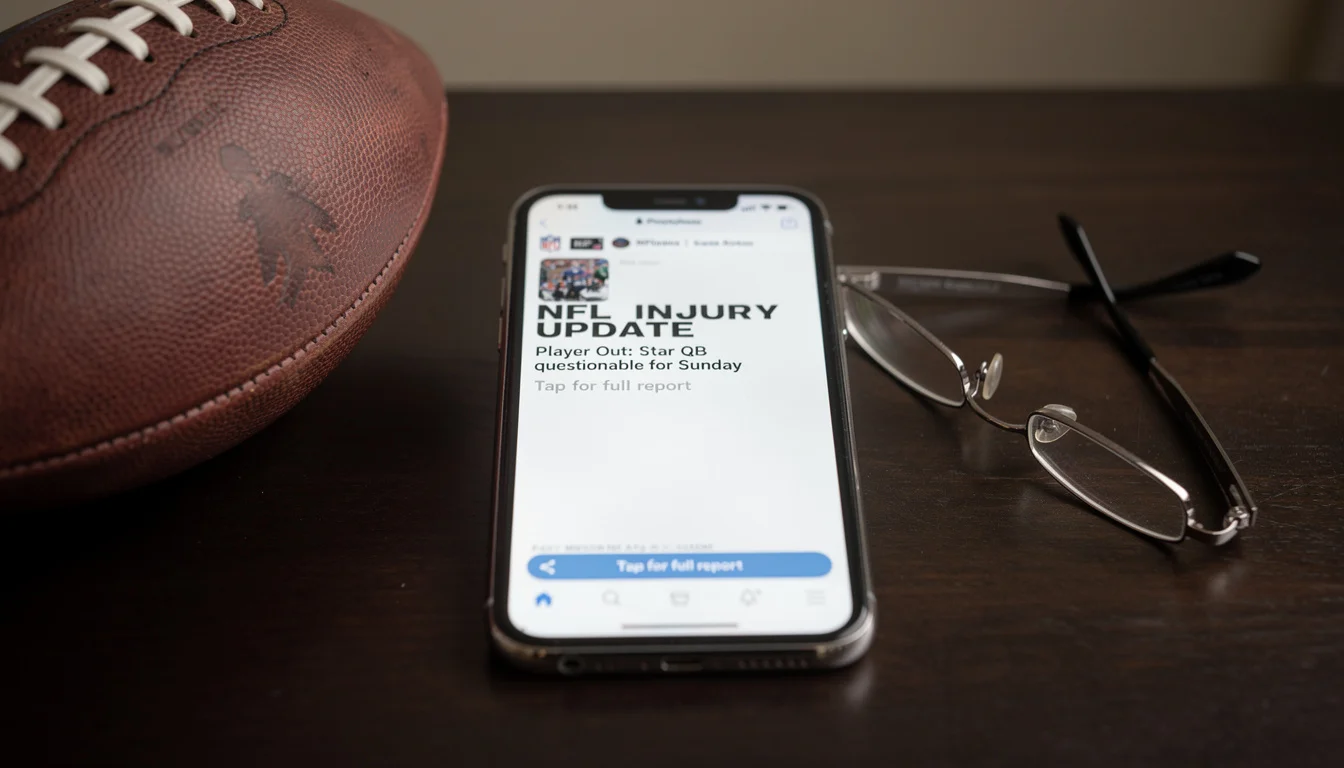
The NFL’s injury reporting system runs on a Wednesday-Thursday-Friday cycle during the regular season, culminating in a game-status designation: out, doubtful, questionable or no designation. For UK punters, the timing is awkward — final inactive lists drop 90 minutes before kick-off, which for a 6:00 PM GMT Sunday game means 4:30 PM on a Sunday afternoon. If you’ve placed a player prop on Saturday evening and the player is ruled out on Sunday, what happens to your bet depends entirely on your bookmaker’s rules.
Most UKGC-licensed sportsbooks void player props when the named player is inactive and doesn’t record a single snap. Some books, however, settle the under as a winner if the player records zero stats — meaning the under on 49.5 passing yards cashes because the player threw for zero. The difference between voiding and settling at zero can swing your P&L significantly over a season, so read the terms before you bet, not after.
Partial participation adds another layer. A quarterback who leaves the game in the second quarter with an injury has his passing yards locked at whatever he accumulated before exiting. Most books settle the prop based on the final stat line regardless of playing time, which means the under often wins in injury-exit situations. I track mid-game injury rates for quarterbacks and running backs specifically because these exits create predictable settlement patterns that the pre-game line doesn’t account for.
Reading a Player Prop Line at a UK Sportsbook
Last autumn, a reader sent me a screenshot of a player prop from a UK sportsbook and asked, “What am I actually looking at?” The screenshot showed: Josh Allen — Passing Yards — Over 262.5 at 1.90, Under 262.5 at 1.92. Let me walk through exactly what those numbers mean, because reading a line accurately is the foundation everything else builds on.
The number 262.5 is the line — the threshold the bookmaker has set. The half-yard ensures there’s no tie. “Over 1.90” means that for every pound you stake on the over, you receive 1.90 back if Allen throws for 263 or more yards. Your profit is 0.90 times your stake. “Under 1.92” means you receive 1.92 for every pound staked if Allen finishes at 262 or fewer yards.
Now, convert those prices to implied probability. The formula is straightforward: 1 divided by the decimal odds, multiplied by 100. So the over at 1.90 implies a 52.6% chance. The under at 1.92 implies 52.1%. Add them together: 104.7%. That sum exceeds 100% by 4.7 percentage points, and that gap is the overround — the bookmaker’s built-in margin. On mainline spreads and totals, the overround at competitive UK books sits around 4-5%. On player props, it often stretches to 6-8%, and on some exotic props it can exceed 10%. That higher margin is part of why props account for such a disproportionate share of bookmaker profits relative to handle.
Understanding implied probability lets you compare the bookmaker’s view to your own. If you believe Allen has a 57% chance of going over 262.5 yards, but the book implies only 52.6%, you have a positive expected value bet. If your estimate is 51%, you’re paying a 1.6% premium over your own projection for the privilege of betting — a losing proposition over any meaningful sample. Every player prop decision starts here: your number versus their number, with the margin as the toll you pay for entry.
Where Statistical Value Hides in Player Props
If I had to name the single biggest source of value I’ve found in player props over nine years, it would be this: lines that haven’t adjusted for a change in role. The bookmaker’s model leans heavily on season averages. When a backup receiver becomes the WR2 because the starter tore his ACL on Wednesday, the market for the backup’s receiving yards might not shift until sharp money forces it. That window — between the injury announcement and the line correction — is where I’ve made the most consistent profit.
You may also find NFL Bet Builder UK: How the Single-Game Customiser Actually Works interesting.
Weather is the second source, and it’s underpriced more often than you’d expect. Wind speeds above 15 mph suppress passing yards and touchdowns but barely affect rushing props. Rain reduces both, but the effect on passing is roughly twice as large as on rushing. Yet I regularly see passing yards lines that sit within a yard of the player’s season average even when the forecast calls for 25 mph gusts. The bookmaker knows about the weather, obviously, but the adjustment is often too small — perhaps because they’re anchoring to the season number and applying a modest discount rather than rebuilding the projection from scratch.
Matchup data is the third pillar. Defensive rankings by position — pass yards allowed to quarterbacks, rushing yards allowed to running backs, targets allowed to slot receivers — are freely available and updated weekly. The sharpest version of this analysis goes beyond team-level numbers and looks at specific coverage defenders. If a cornerback who typically shadows the opponent’s WR1 is injured, the replacement might be significantly weaker, and the WR1’s receiving yards line may not reflect the upgrade in matchup. This is granular work, but it’s the work that separates a punter who grinds out small edges from one who relies on gut instinct.
Finally, look at the correlation between props. A quarterback who goes over his passing yards number is more likely to also go over his passing touchdowns number, because both stats are driven by the same underlying event: sustained passing volume. Understanding which props move together — and which move in opposite directions — is essential if you’re building multi-leg bets. The same-game parlay guide covers correlation mechanics in depth.
Frequently Asked Questions
What is the most popular NFL player prop bet?
The anytime touchdown scorer market consistently leads in handle at major sportsbooks. Receiving yards over/under ranks second, and first touchdown scorer — which pays longer odds but hits less frequently — sits third. These three markets account for the bulk of player prop volume at UK books during the regular season and playoffs.
How are passing yards props settled when a quarterback is benched mid-game?
Most UK bookmakers settle the prop on the player’s final stat line regardless of how much of the game he played. If a QB is benched in the third quarter with 187 passing yards, the under on a 234.5 line wins. Sack yardage is not included in passing yards at most books — only net passing yards on completed and incomplete throws count — but check your specific bookmaker’s settlement rules because some use NFL official stats which exclude sack losses by default.
Can I bet on a player’s first touchdown of the game in the UK?
Yes. The first touchdown scorer market is widely available at UKGC-licensed sportsbooks. It pays significantly higher odds than the anytime touchdown scorer market because you’re predicting not just that a player scores, but that he scores before anyone else. Typical prices for a favoured running back range from 8.00 to 12.00 in decimal format, reflecting an implied probability of roughly 8-12%.
Do UK bookmakers offer NFL kicker props?
Several do, though the range is narrower than for offensive skill positions. You’ll commonly find field goals made over/under, kicker total points and occasionally longest field goal. Availability varies by bookmaker and tends to be best during primetime games and the playoffs, when prop menus expand.
Created by the ”Prop Bets for nfl” editorial team.