Common NFL Prop Betting Mistakes UK Punters Make (And How to Stop)
 Available in US
A pattern of mistakes that quietly drains UK prop bankrolls
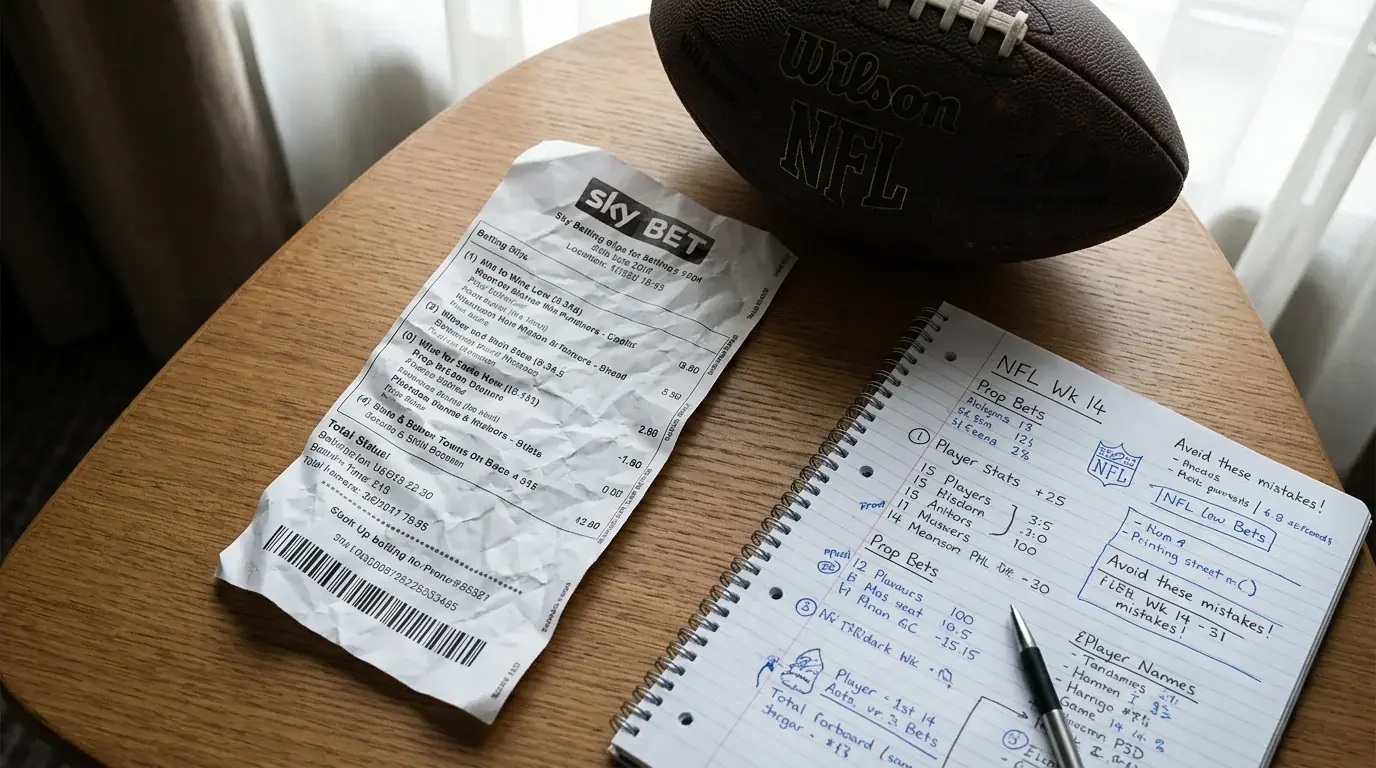
I have kept a record of every NFL prop bet I have placed since 2018. Not just the results — the reasoning. Why I selected the prop, what data I used, what assumptions I made, and whether, in hindsight, those assumptions held. Reviewing that record is humbling. The bets I lost are not randomly distributed. They cluster around the same handful of mistakes, repeated across seasons, each one a pattern I had to consciously break before my results improved.
What makes these mistakes insidious is that they feel like good analysis. Backing a star player off a huge game feels smart. Loading up the bet builder with five legs feels exciting. Ignoring the weather because the player is too talented to be affected feels confident. Every one of these instincts leads to predictable, repeatable losses, and every UK prop bettor I know has fallen into the same traps. Prop bets account for an estimated 15-20% of total NFL handle at online sportsbooks, and a meaningful portion of the bookmaker’s profit from that segment comes from punters who make these mistakes consistently.
Discover everything about prop bets for nfl here.
Overweighting recent form
The single most common mistake I see — and the one I made most often in my first two seasons — is giving too much weight to a player’s most recent performance. A wide receiver catches 11 passes for 140 yards on Sunday, and by Tuesday every punter in the UK is backing his receiving yards over the following week. The line moves up. The value disappears. And the receiver regresses to his season-long average, which is 65 yards, not 140.
Recency bias is a cognitive shortcut that the human brain uses to simplify complex decisions. The most recent data is the most vivid, and vividness gets confused with significance. In NFL player props, the most recent game is one data point in a 17-game season. A single performance tells you very little about the next performance unless it was accompanied by a structural change — a new offensive scheme, a different role in the offence, or a significant matchup shift.
The correction is mechanical. I weight the last three games equally with the season-long average and give no special status to the most recent performance. If a player’s season average is 70 receiving yards and his last three games were 45, 68, and 140, the weighted input is approximately 80 — not 140, and not even 84 (the three-game average). The season-long sample anchors the projection, and the recent data adjusts it modestly. Any approach that lets a single outlier dominate the projection is a recipe for consistently overpriced bets.
Chasing star names over volume data
UK punters are particularly susceptible to the star-name trap because British NFL coverage focuses heavily on the league’s biggest personalities. The quarterback who appears in every highlight package, the running back with the flashiest celebrations, the wide receiver with the most social media followers — these are the players UK punters bet on most heavily, and they are also the players whose prop lines are priced most efficiently.
Bookmakers know that the public will bet on star names regardless of the price. A passing yards over on a top-tier quarterback attracts volume from casual punters who simply want to root for a name they recognise, and that volume pushes the line up and the odds down. The result is that star-player prop lines carry tighter margins than lower-profile players — but they also offer less value, because the price already reflects the public’s enthusiasm.
The edge in prop betting lives in the second and third tier of player visibility. A backup running back who inherits 15 carries because the starter is nursing an injury. A slot receiver whose target share has quietly increased over three weeks. A tight end playing against the worst tight-end coverage unit in the league. These players do not appear in highlight packages. UK punters do not know their names. And precisely because of that anonymity, their prop lines are priced less efficiently. I generate roughly 70% of my prop profits from players that a casual UK fan could not name without checking the roster.
Overstacking the bet builder
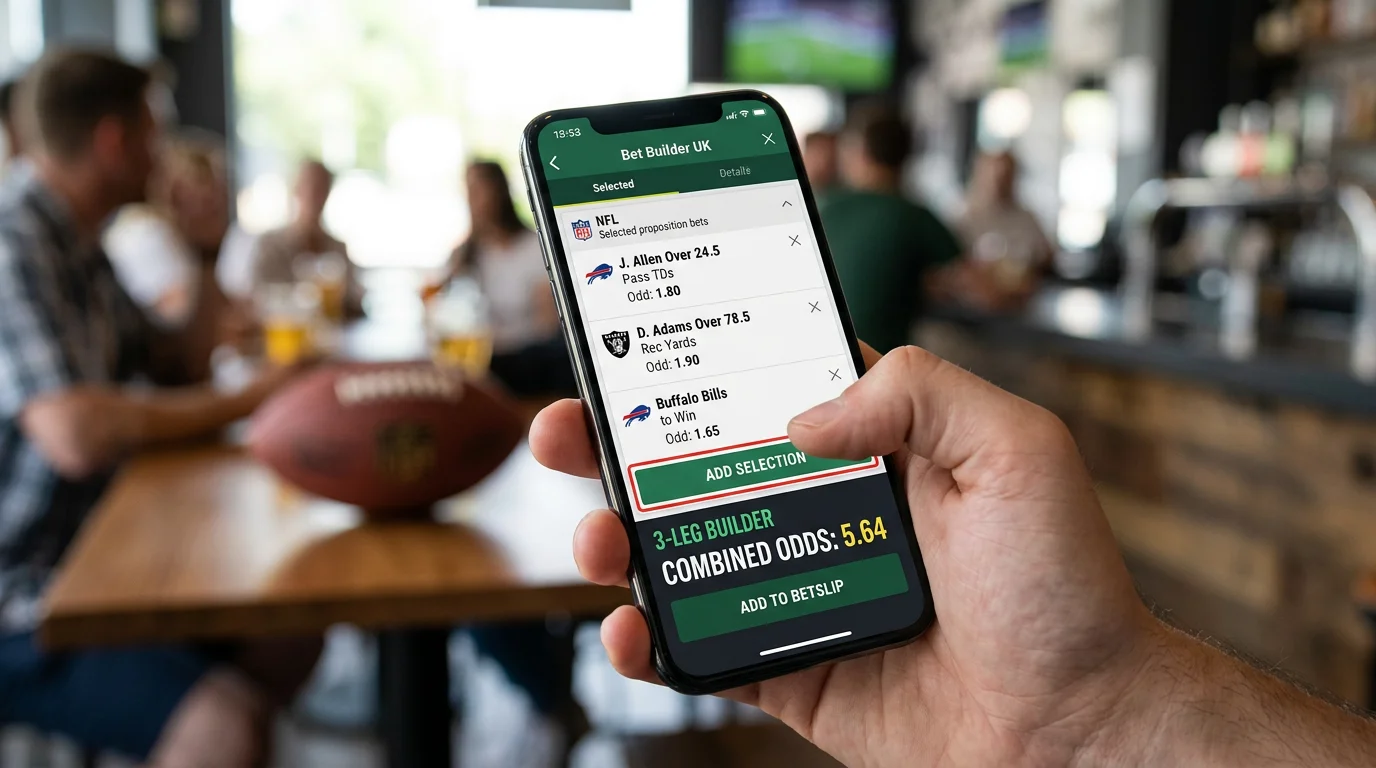
The bet builder is the most profitable product in the UK sportsbook’s NFL menu — profitable for the sportsbook, not for the punter. The tool encourages adding legs because each additional leg increases the combined price and the potential payout. A three-leg builder at 5.00 looks moderate. A five-leg builder at 18.00 looks thrilling. A seven-leg builder at 55.00 looks transformative. The probability of hitting each of those slips decreases exponentially, but the emotional appeal scales linearly with the price.
I cap my bet builders at three legs, and I recommend every UK prop bettor do the same. The mathematics are unforgiving. If each leg has a 55% probability of hitting — which is optimistic for a prop bet — the probability of all three legs hitting is 16.6%. The probability of five legs hitting drops to 5.0%. Seven legs: 1.5%. The combined price compensates for the declining probability, but the margin on each additional leg compounds, so the effective payout is always below the fair value of the combination. The more legs you add, the more margin you pay, and the less likely you are to see a return.
The emotional trap is comparison. A punter who sees a seven-leg builder pay out at 55.00 on social media compares that to their own three-leg builders at 5.00 and feels like they are playing too conservatively. What they do not see is the 20 losing seven-leg builders that the winning punter also placed. Survivorship bias makes long-shot builders look profitable in the same way that lottery winners make lotteries look sensible — by hiding the losses.
Ignoring weather and game script
Weather and game script are the two contextual factors that have the largest impact on NFL player props, and they are the two factors that UK punters most consistently ignore. The information is freely available — weather forecasts and spread-derived game-script expectations are published hours before kickoff — but incorporating it into prop analysis requires effort that many punters skip.
Check out our guide on Building an NFL Prop Betting Strategy: A UK Punter’s Analytical Framework as well.
Wind is the most underrated weather variable. A sustained wind above 15 miles per hour reduces passing volume, suppresses deep-ball attempts, and increases the variance of kicking outcomes. A quarterback’s passing yards line does not usually adjust for wind until the day of the game, which means a punter who checks the weather forecast on Saturday night can identify passing yards overs that are overpriced for Sunday’s conditions. I have tracked wind-related adjustments for three seasons and found that the under on passing yards props in games with 15-plus mph winds hits at approximately 58% — a modest but consistent edge.
Game script is equally important and equally overlooked. A running back’s rushing yards prop is set based on an expected workload that assumes a competitive game. If his team falls behind by two touchdowns in the first half, the game script shifts to pass-heavy, the running back’s touches evaporate, and the rushing yards under becomes heavily favoured. The spread tells you the expected game script before kickoff: a team favoured by 10 points is expected to lead and run the ball; a team trailing by 10 is expected to throw. Aligning your prop selections with the expected game script — rather than ignoring it — is one of the simplest improvements a UK bettor can make.
For a comparison of how these contextual factors affect different betting approaches, the props versus spread betting guide explores the structural differences that make weather and game script more or less relevant depending on the market you are betting.
How many games of data is a fair sample for a prop trend?
A minimum of six games is needed before a trend in player prop results becomes meaningful. Below that threshold, the sample is dominated by noise rather than signal. For season-long trends — like a receiver’s target share increase or a quarterback’s passing volume under a new coordinator — three to four weeks of data can be directionally useful, but projections should still be anchored to the broader season-long average.
Is fading the public a real edge on NFL props?
In isolation, no. ‘Fading the public’ — betting against the popular side — is not a reliable strategy because the public is not wrong often enough to generate a consistent edge. What does work is identifying specific situations where public volume has pushed a line beyond its fair value, typically on star-player props after a high-profile performance. The edge comes from the line movement, not from contrarianism as a principle.
Why do I lose long-shot anytime TD bets so consistently?
Anytime touchdown scorer markets carry overrounds of 10-18%, which is among the highest margins in NFL prop betting. The attractive prices on long-shot selections (tight ends, backup running backs, defensive players) imply probabilities that are significantly lower than the actual implied probability after margin removal. You are paying a premium for every long-shot TD bet, and that premium accumulates into consistent losses over a season-long sample.
Prepared by the Prop Bets for nfl editorial staff.