NFL Prop Odds in Decimal Format: Reading Lines the UK Way
 Available in US
Why UK prop sheets default to decimals
If you have ever opened an American NFL betting guide and stared at a line reading “-110” or “+150” with no immediate sense of what it means, you are not alone. UK sportsbooks display odds in decimal format by default, and that format is one of the few genuine advantages British punters have over their American counterparts — not because decimal odds contain more information, but because they make the maths of prop betting instantly transparent.
A decimal price of 1.91 tells you exactly what you receive for every pound staked: 1.91 pounds back, including your original stake. No mental gymnastics, no conversion tables, no confusion about whether the number represents profit or total return. When I started betting NFL props from the UK nine years ago, the simplicity of decimal odds let me focus on the important question — is this price good? — rather than getting lost in the format. The UK sports betting market generates approximately 2.48 billion pounds in annual gross gaming yield, and the vast majority of that volume flows through decimal-priced platforms.
Discover everything about prop bets for nfl here.
Decimal payout maths
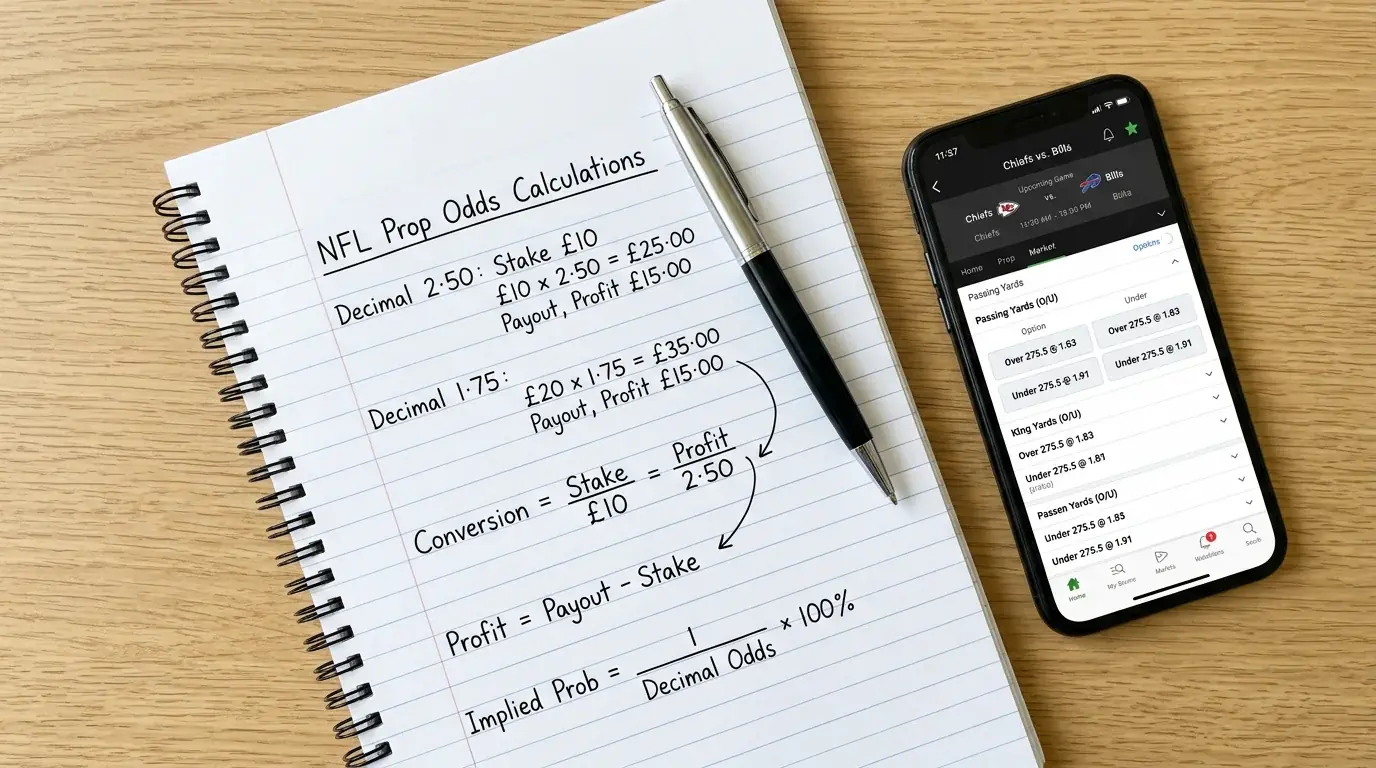
The calculation is the simplest in all of sports betting. Stake multiplied by decimal odds equals total return. A 10-pound bet at 2.15 returns 21.50 pounds — 10 pounds of stake plus 11.50 pounds of profit. A 10-pound bet at 1.75 returns 17.50 pounds — 10 pounds of stake plus 7.50 pounds of profit. The relationship is linear and requires no intermediate steps.
What makes decimal odds particularly useful for prop betting is the ease of comparing prices across markets. If one sportsbook offers a passing yards over at 1.87 and another offers the same line at 1.95, the difference is immediately visible: the second price returns 0.80 pounds more per 10-pound bet. In American format, the same comparison (-115 vs -105) requires you to calculate the return from each before comparing, which slows down the line-shopping process and increases the chance of errors.
For parlays and bet builders, decimal odds compound by multiplication. Two legs at 1.90 each produce a combined decimal price of 3.61 (1.90 multiplied by 1.90). Three legs at 1.80 produce 5.83 (1.80 cubed). This multiplicative property is cleaner than the American system, where parlay calculations require converting each leg to implied probability, multiplying, and converting back. I build every bet builder on paper using decimal multiplication before placing, and the format makes that process take seconds rather than minutes.
Converting decimals to implied probability
This is the single most important calculation in prop betting, and it takes three seconds once you have done it a dozen times. Implied probability equals 1 divided by the decimal odds, expressed as a percentage. A price of 2.00 implies a 50% probability (1 / 2.00 = 0.50). A price of 1.50 implies a 66.7% probability (1 / 1.50 = 0.667). A price of 3.00 implies a 33.3% probability.
The conversion matters because it is the bridge between the number on the screen and the question you actually need to answer: does this player have a higher or lower probability of hitting this line than the price implies? If a sportsbook prices a rushing yards over at 1.85 — implying a 54.1% probability — and your analysis suggests the back will clear the line 60% of the time, the bet has positive expected value. You do not need to know the exact margin of edge; you need to know the direction, and the implied probability tells you which side of the equation you are on.
One subtlety that catches new prop bettors: the implied probabilities on both sides of a two-way market add up to more than 100%. A passing yards over at 1.87 (53.5%) and the under at 2.00 (50.0%) sum to 103.5%. The excess — 3.5 percentage points — is the bookmaker’s overround, the built-in margin that ensures the book profits regardless of the outcome. The true probability of the over is not 53.5%; it is somewhere below that, and the true probability of the under is somewhere below 50.0%. Understanding that the displayed price always overstates the implied probability — on both sides — is essential to avoiding the trap of thinking a bet is fair when it is actually margin-laden.
Decimal vs American format for the same prop
Most NFL content consumed by UK punters is produced in America, which means the odds are displayed in American format. Learning to read both is unavoidable if you want to use American research to inform UK bets. The conversion is mechanical once you know the rules.
For negative American odds (favourites), the formula is: decimal = 1 + (100 / absolute value of the American odds). An American line of -150 converts to 1 + (100 / 150) = 1.667 in decimal. For positive American odds (underdogs), the formula is: decimal = 1 + (American odds / 100). An American line of +150 converts to 1 + (150 / 100) = 2.50 in decimal.
The critical insight is that American odds obscure the margin more effectively than decimal odds. A line of -110 on both sides of a market looks symmetrical, but the decimal equivalent (1.909 on both sides) reveals the overround immediately: the implied probabilities sum to 104.8%. In decimal format, you can calculate the margin in your head. In American format, you need a calculator. This is why I recommend every UK punter keep their sportsbook settings on decimal and only convert American odds when consuming US-produced content — never switch your native format to match American sources.
Reading mixed-source NFL content as a UK punter
The reality of NFL prop research in 2026 is that the best analytical content comes from American writers working with American odds. Strategy articles, player projection models, and prop-specific podcasts almost universally quote lines in -110, +130, -200 format. If you cannot translate on the fly, you lose the ability to assess whether the conclusions apply to your UK prices.
Check out our guide on NFL Quarter and Half Props: Segment Betting Explained for UK Punters as well.
I keep a simple mental conversion table for the American odds I encounter most frequently in NFL prop content. -110 is 1.91 — the standard juice on most two-way props. +100 is 2.00 — the break-even point. +150 is 2.50 — a common price for moderate underdogs. -200 is 1.50 — a heavy favourite. With those four anchors memorised, I can approximate any American line within 0.05 of the decimal equivalent, which is close enough for real-time analysis.
The more important skill is recognising when an American source’s strategic advice does not transfer to UK markets. An American writer recommending a player prop at +120 assumes you can get 2.20 in decimal. If your UK sportsbook offers only 2.10 for the same line, the edge the writer identified may no longer exist. The strategy is sound; the price is not. I always verify the recommended price against my UK books before acting on American research, and I discard any play where the UK price is more than 0.10 below the American equivalent.
The mechanics of decimal odds feed directly into the vig and margin analysis that underpins every serious prop betting approach — understanding how the margin is built into the price is the first step toward identifying when that margin is unusually wide or narrow.
How do I convert American +150 to decimal odds?
Add 1 to the American odds divided by 100. For +150: 1 + (150 / 100) = 2.50 in decimal. This means a 10-pound bet returns 25 pounds total (15 pounds profit plus 10 pounds stake). For negative American odds like -150: 1 + (100 / 150) = 1.667 in decimal.
Why are some UK books showing fractional NFL prop odds?
Some UK sportsbooks default to fractional odds (e.g. 5/4, 10/11) for legacy reasons or because the punter’s account settings specify fractional format. You can almost always switch to decimal format in your account settings. Fractional odds are functionally identical to decimal — 5/4 equals 2.25, 10/11 equals 1.909 — but decimal format makes comparison and calculation faster for prop betting purposes.
What decimal price corresponds to a fair coin-flip prop?
A true 50/50 outcome corresponds to a decimal price of 2.00 on each side. In practice, you will never see 2.00 on both sides of a prop because the bookmaker’s margin means both sides are priced below 2.00. A typical coin-flip prop might be priced at 1.91 on each side, implying a combined probability of 104.7% — the 4.7% excess is the book’s overround.
Published by the Prop Bets for nfl team.