Cash Out on NFL Prop Bets: When It Helps and When It Costs You
 Available in US
What cash out really is at a UK sportsbook
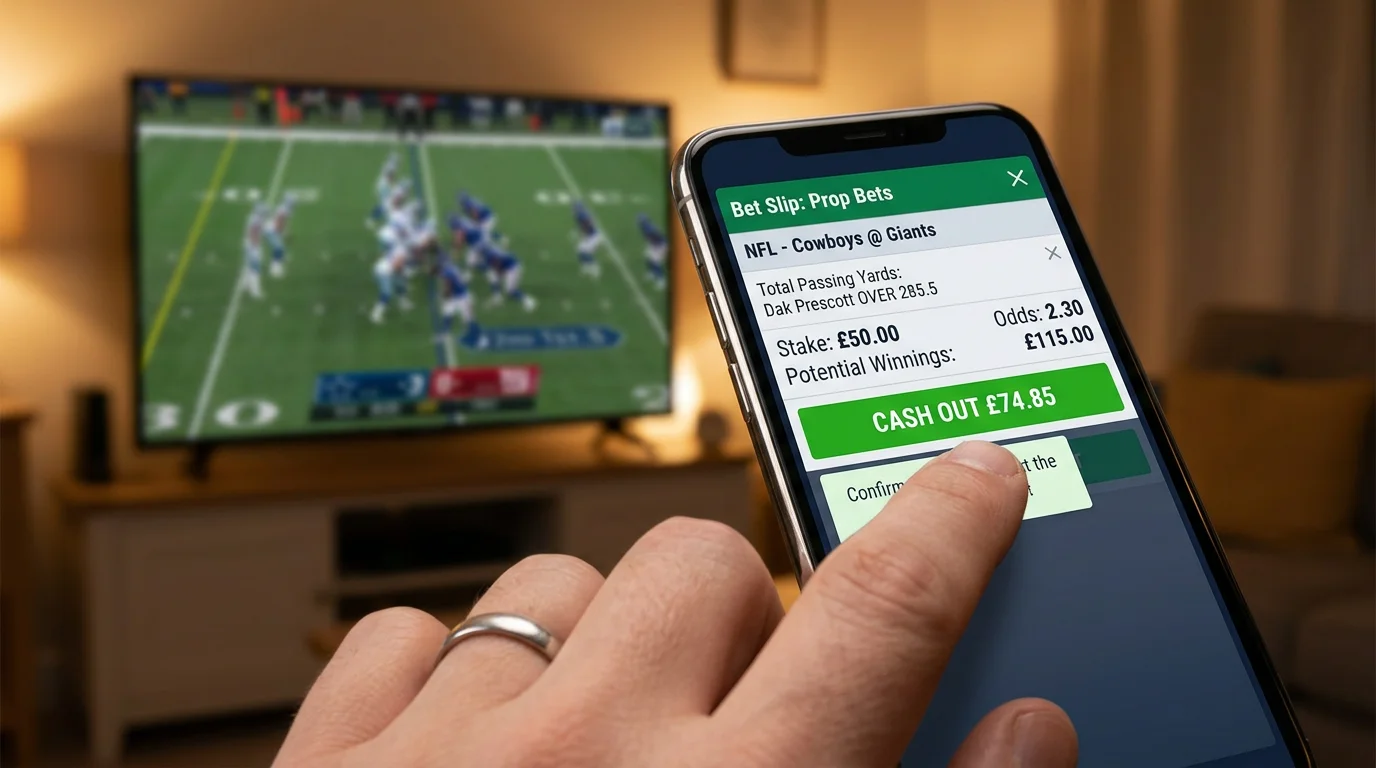
Cash out sounds like a gift from the bookmaker — a chance to take your money and walk away before the final whistle. In reality, it is a second bet embedded inside your first one, and the price is set by the same trading desk that priced the original line. Understanding this distinction is the difference between using cash out as a strategic tool and using it as an emotional crutch that bleeds your bankroll over time.
I remember the first time I cashed out an NFL prop bet. It was a rushing yards over that was tracking beautifully at halftime, and the book offered me 78% of my potential payout to close the bet early. I took it, felt clever, and watched the back finish with 40 more yards than I needed. I left money on the table because I confused anxiety relief with risk management. That experience cost me less than the bet was worth, but the lesson was more valuable than any single payout.
At its core, cash out is the bookmaker buying back your bet at a price that includes their margin. The cash-out offer is calculated from the live odds of your remaining selections, minus the book’s spread. If your prop bet has a 70% probability of winning at the time of the cash-out offer, the book does not offer you 70% of your potential return — it offers you something closer to 60-65%, keeping the difference as margin. The 10% of UK adults who actively participate in online sports betting encounter this feature constantly, and most accept the offer without calculating whether the implied probability justifies the price.
Discover everything about prop bets for nfl here.
How cash out is priced
The mechanics are more transparent than most punters realise. When you place a bet, the book prices it at a given implied probability with their margin built in. When you request a cash-out, the book recalculates the implied probability based on current information — the live score, player performance so far, game context — and then applies their margin to the updated probability.
The margin on cash-out offers is typically 5-15% wider than the margin on the original bet. This is not a conspiracy — it reflects the additional risk the book assumes by offering a guaranteed payout during a live event. The book must hedge its exposure when it buys back your bet, and the cost of that hedge is passed to you.
Consider a concrete example. You backed a wide receiver over 65.5 receiving yards at 1.90 with a 10-pound stake. At halftime, the receiver has 48 yards and the live line for his full-game total sits at 72.5. The book calculates that your bet now has a roughly 75% chance of winning. A fair cash-out price would be 75% of your potential return (19 pounds including stake), which is 14.25 pounds. The actual cash-out offer might sit at 12.50 to 13.00 pounds — the difference is the margin the book takes for providing the early settlement option.
The size of that margin varies by sportsbook, by market, and by game state. Early in the game, when uncertainty is highest, the cash-out margin tends to be wider. Late in the game, when the outcome is more certain, the margin narrows — but by that point, the cash-out offer is either very close to your full payout (if the bet is tracking well) or very small (if it is tracking poorly), reducing the strategic value of the feature.
Partial cash out and why it differs
Partial cash out allows you to close a portion of your bet while leaving the remainder active. If the book offers a full cash-out of 13 pounds on your 10-pound bet, you might choose to cash out 50%, taking 6.50 pounds guaranteed while leaving 5 pounds of exposure on the original bet. This is the most underused feature in UK sports betting, and it is the one I find genuinely valuable.
The mathematics of partial cash out are identical to full cash out on a per-pound basis — the margin is the same. The strategic advantage is psychological and structural. Partial cash out locks in a portion of your return, reducing the emotional stakes of the remaining bet. You are no longer risking your entire stake; you are playing with a combination of guaranteed return and residual upside. This reframing makes it easier to let the remaining portion ride to settlement rather than making another impulsive cash-out decision later.
I use partial cash out in one specific situation: when a prop bet is significantly ahead of pace at halftime and I believe the second-half pace may slow. Cashing out 40-60% secures a positive return regardless of the outcome, while the remaining stake captures the full payout if the bet completes. The key is doing this only when the halftime assessment is genuine analysis, not fear. If I am cashing out because I am afraid the bet will lose, I should either cash out fully or not at all — partial cash out should be a strategic choice, not a compromise born of indecision.
Auto cash out and trigger rules
Several UK sportsbooks offer an auto cash-out feature that triggers when the cash-out value reaches a specified amount. You set a target — say, 15 pounds on a bet with a maximum payout of 19 — and the system automatically closes the bet if the offer hits that level.
The appeal is obvious: you define your exit price in advance and remove the emotional element from the decision. In practice, auto cash out has a significant limitation. The system evaluates the cash-out price at intervals — not continuously — and the price can move past your trigger without being captured. In fast-moving NFL games, a player might accumulate yards rapidly during a drive, pushing the cash-out value above your trigger, but the system only checks at fixed intervals and may not execute until the price has already retreated. The result is missed exits and a false sense of automation.
I have experimented with auto cash out across two seasons and found it useful for one specific purpose: overnight hedging on futures or week-long prop bets. If I have a season-long player prop that has moved heavily in my favour due to an injury to a competitor, I set an auto cash-out trigger at a level that guarantees a profitable exit. This removes the temptation to hold the bet indefinitely and protects against news events (a trade, a coaching change) that could reverse the value overnight. For in-game prop bets, I find manual cash-out decisions more effective because the context changes too rapidly for a static trigger to capture.
When cashing out is a rational move
Cash out is rational in a narrower set of circumstances than most punters believe. The default position should be to let your bets settle at their natural conclusion, because every cash-out interaction costs you margin. The book does not offer cash out as a favour — it offers it because, on average, it is profitable for the book.
The situations where cash out adds genuine value involve a change in information that was not available when you placed the bet. If you backed a rushing yards over and the running back’s team falls behind by 21 points in the first half, the game script has changed fundamentally — the team will abandon the run, and your bet’s probability has dropped sharply. Cashing out in this scenario is rational because the new information has invalidated your original thesis, and the cash-out price — even with its margin — is better than the expected return of a bet whose foundation has collapsed.
Check out our guide on Correlated NFL Prop Bets: What Correlation Means for UK Punters as well.
Another rational scenario is injury. If you backed a quarterback over 260.5 passing yards and he leaves the game in the second quarter with a hand injury, the backup quarterback is unlikely to generate the same volume. The cash-out price will drop, but whatever the book offers is almost certainly better than the probability of the backup hitting the original line. Take the cash out immediately — do not wait for more information, because the price will only deteriorate as the market processes the injury.
The irrational cash out — the one that erodes long-term ROI — is the one driven by anxiety rather than information. If your bet is tracking to plan and no new information has emerged, the cash-out price is a guaranteed loss of margin relative to holding the position. UK sportsbooks generate approximately 6.9 billion pounds in remote-sector gross gaming yield, and a meaningful portion of that revenue comes from punters who cash out winning bets early and pay the margin for the privilege.
For a broader view of how live market mechanics influence the cash-out decision, the live prop betting guide covers price movement, latency, and the discipline required to bet in-play without reacting emotionally.
Why is the cash-out price often lower than expected value?
The cash-out price includes the bookmaker’s margin on top of the recalculated probability. If your bet has a 70% chance of winning, the fair cash-out value would reflect that 70%. The actual offer is lower — typically reflecting 60-65% — because the book deducts its margin for providing the early settlement service. This margin is the cost of certainty.
Can I cash out a same-game parlay leg by leg?
No. At UK sportsbooks, same-game parlays are settled as a single bet. You can cash out the entire SGP at once, but you cannot selectively close individual legs while leaving others active. The all-or-nothing structure is a consequence of how SGP pricing works — the legs are interdependent, and removing one changes the probability of the remaining combination.
Does cashing out early hurt long-term ROI?
Yes, if done habitually. Every cash-out transaction costs you margin relative to holding the bet to settlement. Over hundreds of bets, the cumulative margin paid on unnecessary cash-outs can reduce your ROI by 2-5 percentage points. Cash out should be reserved for situations where new information has changed the bet’s thesis, not used as a routine anxiety-management tool.
Prepared by the Prop Bets for nfl editorial staff.