UK Bookmakers for NFL Props: Market Depth, Limits and What Actually Matters
 Available in US
Table of Contents
- What “Best for Props” Really Means at a UK Book
- The UKGC Licensing Baseline
- Market Depth: How Many Prop Lines Per Game Matter
- Price and Margin: Comparing Hold Across UK Books
- Bet Builder and Same-Game Parlay Tooling
- Live Prop Coverage During NFL Windows
- Exchange vs Traditional Sportsbook for Props
- Stake Limits, Restrictions and Account Treatment
- A Practical Evaluation Method for Punters
- Frequently Asked Questions
What “Best for Props” Really Means at a UK Book
Every September, I get the same question from at least a dozen people: “Which bookmaker should I use for NFL props?” And every time, I give the same unsatisfying answer: “It depends on what you mean by best.” Because the word “best” in this context hides three or four completely different questions, and the answer to each one points to a different platform.
If “best” means the widest selection of player prop markets per game, you’re looking at one set of operators. If it means the tightest margins on those markets, the list changes. If it means the most generous stake limits before your account gets flagged, you’re down to a very short list indeed. And if it means the slickest bet builder interface for combining props into same-game parlays, you’re somewhere else entirely.
The UK sports betting market generates approximately 2.48 billion pounds in annual gross gaming yield, and a meaningful slice of that comes from American football wagering — particularly during the NFL season when prop volumes spike. This guide doesn’t rank bookmakers or hand out affiliate-driven recommendations. Instead, it gives you a framework for evaluating any UKGC-licensed sportsbook against the specific criteria that matter for NFL prop betting, so you can make the decision yourself with open eyes.
Find the best options for prop bets for nfl.
The UKGC Licensing Baseline
Before evaluating any sportsbook on prop-specific criteria, you need to confirm one thing: does it hold a valid UK Gambling Commission licence? This isn’t a formality. The UKGC licence is the floor, not the ceiling, and operating without one means the operator sits outside the regulatory framework that protects your deposits, enforces fair settlement and provides dispute resolution.
The overall UK gambling industry generated 11.5 billion pounds in gross gaming yield for the period April 2023 to March 2024, a 5.7% increase on the previous year. The remote sector alone — which includes all online sportsbooks — accounted for 6.9 billion pounds of that total, growing at 6.9% year on year. Those figures matter because they indicate a mature, well-regulated market where operators have strong commercial incentives to maintain their licences and comply with UKGC rules. A book that risks losing access to this revenue stream is a book that generally follows the regulations.
What the licence guarantees, practically speaking: segregated customer funds (your deposit is ring-fenced if the operator goes insolvent), transparent terms and conditions for bet settlement, access to an approved alternative dispute resolution service, and mandatory responsible gambling tools including deposit limits, self-exclusion and reality checks. None of these protections apply if you bet with an unlicensed offshore operator, regardless of how attractive their prop markets or bonuses might appear.
Checking a licence takes thirty seconds. Visit the UKGC’s public register, type in the operator’s name, and confirm the licence is active. If it doesn’t appear, walk away. Bill Miller, the AGA’s president and CEO, noted that record revenues and tax contributions from the regulated market demonstrate its broad appeal — and that appeal rests on the trust that regulation provides. The same logic applies in the UK: the system works because the rules are enforced, and enforcement only covers licensed operators.
Market Depth: How Many Prop Lines Per Game Matter
I log into five different UK sportsbooks every Thursday evening during the NFL season to count one thing: how many individual player prop lines each book has posted for the Sunday slate. The variation is staggering. One book might offer 35 player prop lines per game — covering passing yards, rushing yards, receiving yards, receptions, touchdowns and completions for every relevant player. Another book might post 12 lines for the same game, limited to the star quarterback, the lead running back and one receiver.
Market depth matters because it determines your opportunity set. If you’ve built a model that identifies value on a tight end’s reception total, but your bookmaker doesn’t offer that market, the edge is worthless. A deeper menu doesn’t just give you more options — it gives you more chances to find mispriced lines, because bookmakers tend to invest their sharpest pricing effort into the highest-volume markets (passing yards, anytime TD) and leave thinner markets like kicker props and defensive sacks with wider margins and softer lines.
The anytime touchdown scorer market is the single most popular player prop by handle, with receiving yards over/under in second place and first touchdown scorer third. Every serious UK sportsbook covers these three. The differentiation begins below that tier. Does the book offer completions for quarterbacks? Carries for running backs? Tackles for linebackers? Head-to-head matchup props? The further down the menu you go, the more the field narrows.
Depth also fluctuates by game prominence. A Sunday afternoon game between two mid-table teams might get a skeleton prop menu, while a Thursday Night Football showcase or a playoff game gets the full treatment with 50+ lines. If your strategy focuses on primetime games, most UK books will serve you adequately. If you want to bet props on every game in the Sunday 6:00 PM GMT window, you need to be pickier about which books you hold accounts at.
Price and Margin: Comparing Hold Across UK Books
Two UK books can offer the same passing yards line at 249.5 and still give you meaningfully different propositions. One prices the over at 1.87 / under at 1.95. The other prices it at 1.83 / under at 1.99. The line is identical, but the margin the book charges is not. That margin — the overround — is the single most important price-related factor for any punter who bets regularly, because it compounds across hundreds of bets over a season.
Calculating overround on a two-way prop is simple: convert both decimal prices to implied probabilities (1 / odds), sum them, and subtract 100%. For the first book above: (1/1.87) + (1/1.95) = 53.5% + 51.3% = 104.8%, so the overround is 4.8%. For the second: (1/1.83) + (1/1.99) = 54.6% + 50.3% = 104.9%. Nearly identical in this example, but I’ve measured overrounds on UK prop markets ranging from 4% on flagship passing yards lines to 12% or more on exotic defensive props.
The trap is assuming that the book with the lowest margin on one market has the lowest margin on all markets. In practice, operators apply different margin strategies to different prop types. A book might price passing yards competitively to attract volume, then recover margin on anytime touchdown scorer markets where casual punters are less price-sensitive. My approach is to identify which book offers the best margin on each prop type I bet regularly, and route my bets accordingly. It’s more effort than using a single account, but the margin savings over a 17-week season are real.
Price and margin are two different things, and conflating them is a common error. A book might have a wider margin (higher overround) but still offer the best available price on a specific prop because it’s set a different line. If one book has over 249.5 at 1.87 and another has over 252.5 at 1.95, the second book has a higher number but a better price. The best practice is to evaluate both: what line am I getting, and what price am I getting it at?
Bet Builder and Same-Game Parlay Tooling
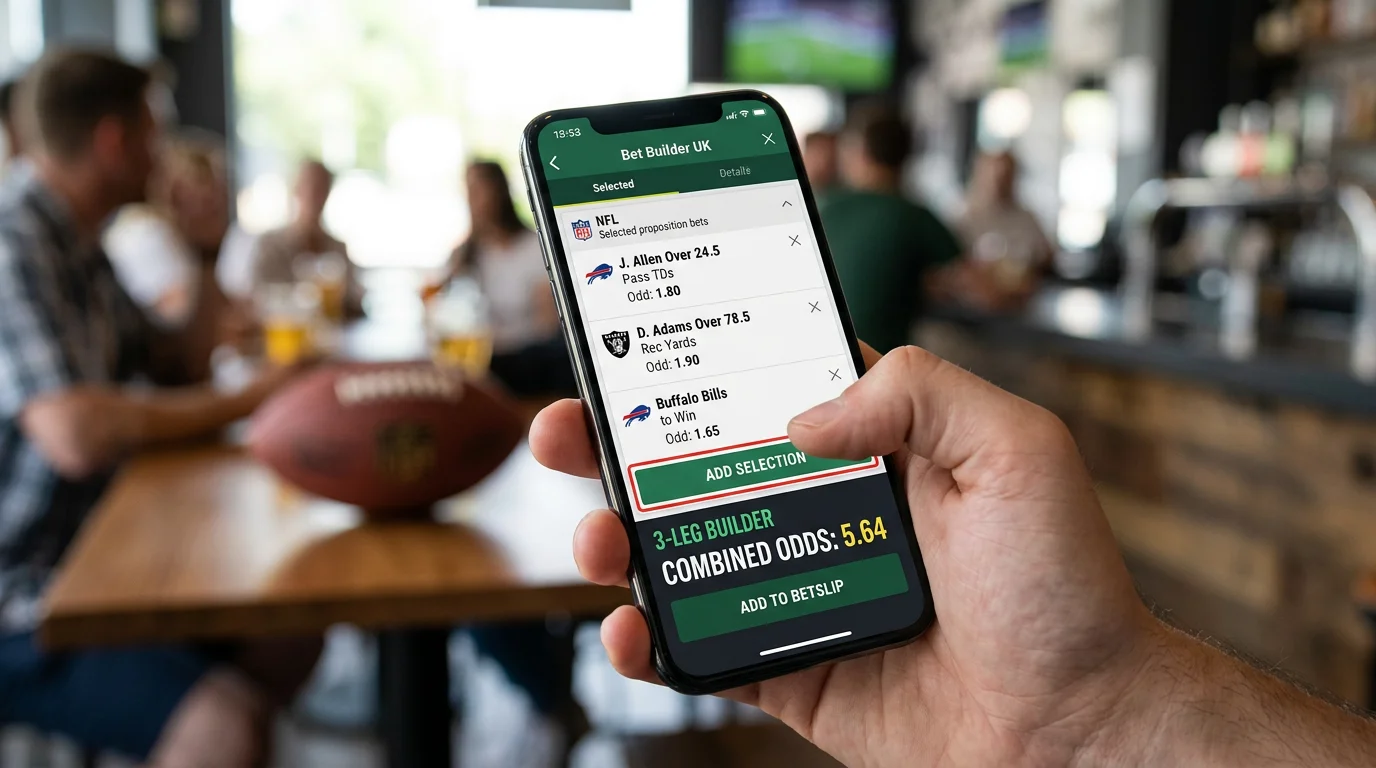
Same-game parlays have continued to skyrocket in volume across the NFL, and every major UK sportsbook has responded by building or upgrading its bet builder tool. The concept is straightforward: select multiple prop outcomes from the same game, combine them into a single bet, and receive a combined price that reflects (roughly) the multiplied probability of all legs hitting. The execution varies wildly from book to book.
The first differentiator is which markets are eligible for inclusion. Some builders allow you to combine player props with game-level props — for example, a quarterback’s passing yards over with the game total over with the same player’s anytime touchdown. Others restrict combinations to avoid highly correlated legs, preventing you from pairing a player’s passing yards over with his completions over because both are driven by the same underlying pass volume. The restrictions make mathematical sense from the bookmaker’s perspective, but they limit your ability to construct certain thesis-driven parlays.
The second differentiator is pricing. No UK book prices a same-game parlay by simply multiplying the individual leg odds together, because that would ignore correlation between outcomes. Instead, the builder applies a correlation adjustment that typically reduces the combined payout. The size of that adjustment varies between operators, and it’s almost never transparent to the punter. Two books with identical individual leg prices can produce different SGP payouts because their correlation models differ. I’ve seen payout differences of 15-20% on the same three-leg combination across UK platforms.
The interface quality matters more than most people admit. A clunky builder that takes four taps to add each leg discourages experimentation, while a smooth interface lets you test combinations quickly and spot which legs the book rejects. Speed of bet placement is also relevant during the live-prop window, when prices shift rapidly and a slow builder can cost you the price you wanted. The bet builder guide walks through how to build balanced slips and avoid common pricing traps.
Live Prop Coverage During NFL Windows
NFL games for UK punters fall into three broadcast windows: the early Sunday slate (6:00 PM GMT), the late Sunday slate (9:05 or 9:25 PM GMT) and the Sunday/Monday/Thursday night game (typically 1:20 AM GMT on a weeknight). Live prop coverage tracks those windows unevenly. 48% of NFL bettors prefer pre-game wagers and only 25% gravitate toward live bets, but the 25% who do bet in-play need a book that keeps prop markets open and accurately priced during game action.
Most UK sportsbooks offer live player props on the main Sunday afternoon games, particularly for high-profile matchups. Passing yards, rushing yards and next touchdown scorer are the markets most commonly available in-play. However, the depth of in-play props thins dramatically for the late window and night games, partly because UK trading desks scale down staffing for games that kick off past midnight local time. If you plan to bet live props on Monday Night Football, check whether your book actually keeps those markets open during the broadcast.
Latency is a real concern. The prices you see on screen reflect a model that’s fed by a data provider tracking play-by-play stats. That feed runs on a slight delay — typically 3-8 seconds behind the live television broadcast, which itself runs 5-10 seconds behind the stadium action. If you’re watching a play develop and see an outcome that affects a prop (a big run, a sack), the live price may not have adjusted yet. Some books manage this by suspending markets during plays and reopening between snaps. Others leave the market open and accept the risk of stale prices. Understanding your book’s approach to live market management prevents you from being surprised by rejected bets or voided wagers.
Exchange vs Traditional Sportsbook for Props
Betting exchanges operate on a fundamentally different model from traditional sportsbooks, and for NFL prop betting, that difference matters in specific ways. At a sportsbook, you bet against the house. The book sets the price, absorbs the risk and profits from the margin. On an exchange, you bet against other punters. The exchange facilitates the match and takes a commission on winning bets, typically 2-5%.
The theoretical advantage of the exchange is lower margin. Because you’re trading with other punters rather than against a bookmaker’s overround, the effective cost of placing a bet is often lower — particularly on popular markets where liquidity is strong and the bid-ask spread is tight. For NFL point spreads and totals, the exchange can offer meaningfully better prices than a traditional book.
The practical limitation for props is liquidity. NFL player prop markets on UK exchanges are thin compared to match odds and totals. You might find decent liquidity on a quarterback’s passing yards for a Sunday afternoon game, but a tight end’s reception total or a kicker’s field goals made? The market may have no offers at all, or only one with a wide spread. Placing a 50-pound bet on a prop at an exchange is straightforward. Placing a 200-pound bet might require splitting across multiple price levels, and the average price you receive could be worse than the sportsbook’s flat offering.
The exchange also allows you to lay bets — to back the “under” side by offering odds to someone who wants the “over.” This is useful for hedging existing prop positions or for situations where you have strong conviction that a prop will miss (for example, a quarterback’s passing yards under in a windstorm). Traditional sportsbooks offer the under too, of course, but the exchange sometimes prices it more favourably because the punter on the other side is a recreational bettor willing to accept a worse price for the entertainment value of the over.
Stake Limits, Restrictions and Account Treatment
Here’s the part nobody in the affiliate space wants to discuss: if you’re good at this, your accounts will eventually be restricted. Every UK sportsbook reserves the right to limit your maximum stake on any market, and prop markets are among the first to get capped because the books know their lines are softer there.
The mechanics are opaque but the pattern is consistent. You open an account, bet props successfully for a few months, and one day you try to place a 50-pound bet on a rushing yards over and the maximum accepted stake is 4.73 pounds. No warning, no explanation, no appeal. The book hasn’t closed your account — they’re still happy for you to bet on football match odds at full limits — but your access to prop markets has been quietly throttled.
This happens because prop markets are lower-liquidity, lower-volume environments where the bookmaker’s model is less confident. A winning punter on props costs the book disproportionately, because the margin that’s supposed to protect them is being consistently overcome. From the bookmaker’s perspective, limiting is rational risk management. From the punter’s perspective, it’s the tax you pay for being profitable.
The mitigation strategy is twofold. First, spread your volume across multiple books. If you’re placing all your prop bets at a single operator, your betting pattern is easy to identify. Distributing bets across four or five platforms reduces the signal each book receives and extends the useful life of each account. Second, mix your prop bets with recreational-looking activity. An account that places five sharp prop bets per week and nothing else looks very different from an account that also bets on football accumulators, backs a few horses and uses the occasional free bet promotion. I’m not suggesting you bet unprofitably on other sports — just that a diverse betting profile delays the onset of restrictions on the markets you actually care about.
A Practical Evaluation Method for Punters
Rather than asking “which is the best book,” ask five specific questions about any platform you’re considering for NFL props. Score each one, and the aggregate tells you whether the book fits your needs.
How many player prop markets does it post for a typical Sunday game? Fewer than 20 is limited; 30-40 is solid; 50+ is deep. What is the average overround on its two-way player props? Below 5% is competitive; 6-8% is standard; above 8% is expensive. Does it offer a bet builder that accepts three or more prop legs from the same game? If not, same-game parlays require a different platform. Does it keep live prop markets open for the full duration of NFL games, including late-window and primetime fixtures? And finally, what is the realistic maximum stake it accepts on player props for a regular account — not a VIP, not a new signup taking advantage of early generosity, but a standard punter six months into the relationship?
Run this evaluation at the start of each NFL season, because operators change their offerings year to year. A book that had thin NFL coverage in 2025 might expand aggressively for the 2026 season as the UK’s NFL fanbase continues to grow. Conversely, a book that offered generous prop limits last year might tighten them after absorbing losses to sharp punters. The landscape is dynamic, and your bookmaker portfolio should be too.
Read our detailed review of UKGC Regulations Around NFL Betting: What UK Punters Need to Know.
Frequently Asked Questions
What licensing and operational signals separate a strong NFL prop book from a weak one?
A strong prop book holds an active UKGC licence, posts 30 or more player prop markets per game, maintains overrounds below 6% on flagship markets, offers a functional bet builder for same-game parlays and keeps live prop markets open throughout all broadcast windows. Beyond these measurable criteria, look for transparent settlement rules, responsive customer support for bet queries and a track record of not aggressively limiting recreational accounts within the first few months.
Do UK bookmakers limit winning prop bettors?
Yes. Most UK sportsbooks will reduce the maximum accepted stake on prop markets for accounts that show consistent profitability. This can happen within weeks or months depending on the volume and visibility of your betting pattern. The best defence is spreading your activity across multiple licensed platforms and maintaining a mixed betting profile rather than exclusively targeting props.
Which UK platforms offer NFL prop trading on an exchange?
Exchange-style betting on NFL props is available at a small number of UK-licensed platforms. Liquidity on NFL prop markets is significantly thinner than on match odds or totals, which means you may not always find a counterparty willing to match your bet at an acceptable price. The exchange model works best for high-profile games and popular prop types like passing yards and anytime touchdowns.
Why do prop odds differ so much between UK bookmakers?
Each bookmaker uses its own pricing model, risk tolerance and margin structure. Props receive less modelling attention than mainline markets, so there is more room for operators to disagree on the correct price. Additionally, operators adjust lines based on the action they receive from their own customer base, which differs from book to book. These structural differences create the price variation that makes line shopping valuable.
Prepared by the Prop Bets for nfl editorial staff.