Bankroll Management for NFL Prop Bets: Staking Plans That Survive Variance
 Available in US
Why prop variance demands a smaller unit than mainline bets
In my second season of serious NFL prop betting, I had a stretch of 14 consecutive losing bets. Every single one was a play I would make again with the same information — the analysis was sound, the prices were fair, and the outcomes fell on the wrong side of the line by narrow margins. If I had been staking 5% of my bankroll on each bet, that streak would have consumed 70% of my capital before I hit a winner. Instead, I was staking 1.5%, and the drawdown — while uncomfortable — was survivable.
NFL prop bets are inherently higher-variance than spreads and game totals. A point spread is a prediction about the aggregate performance of two teams across 60 minutes of football. A player prop is a prediction about a single individual’s output, which is subject to game script, injury, play-calling whims, and matchup-specific factors that can override even the most thorough analysis. The narrower the outcome dependency, the higher the variance, and the smaller your individual stakes need to be.
Prop bets represent 15-20% of total NFL handle at online sportsbooks, but the punters who bet them successfully allocate a disproportionately small percentage of their bankroll to each individual wager. The mismatch between handle share and unit size is not a contradiction — it reflects the reality that prop volume is spread across dozens of bets per week at small stakes, not concentrated in a few large plays.
Find the best options for prop bets for nfl.
Defining a bankroll you can actually lose
The first rule of bankroll management is the hardest one to follow: your betting bankroll must be money you can lose entirely without affecting your life. Not money you would prefer not to lose. Not money you could technically afford to lose but would feel terrible about. Money that, if it disappeared overnight, would not change your rent, your meals, or your stress levels.
I know that sounds like boilerplate advice, and it is — but the reason it gets repeated is that most bettors violate it and then wonder why they make poor staking decisions. Anxiety about money you cannot afford to lose warps every decision you make: you chase losses, you oversize bets on high-conviction plays, you cash out winners early to reduce exposure, and you avoid the disciplined flat-staking approach that long-term profitability requires. The bankroll is a tool. If losing the tool causes panic, the tool is too expensive.
For a UK punter starting with prop betting, I recommend a bankroll that represents no more than one month’s discretionary spending — the amount you would normally allocate to entertainment, dining out, and non-essential purchases. If that number is 200 pounds, your bankroll is 200 pounds. If it is 500, your bankroll is 500. The amount matters less than the psychological separation: this is betting money, not living money, and the distinction must be absolute.
Flat vs percentage staking on props
Flat staking means betting the same amount on every play, regardless of confidence level. Percentage staking means betting a fixed percentage of your current bankroll on each play, which means the stake increases as the bankroll grows and decreases as it shrinks. Both approaches have merit, and the choice depends on your temperament and experience level.
I used flat staking for my first three seasons and switched to percentage staking in year four. The transition improved my long-term results, but it also required a level of discipline that I did not possess as a beginner. Flat staking is simpler and more forgiving of mistakes — if you set your unit at 2% of your starting bankroll and never deviate, the worst-case scenario over a 15-bet losing streak is a 30% drawdown, which is recoverable. Percentage staking adjusts automatically — after losses, your stakes shrink, which protects the bankroll during cold streaks but also means you bet less when you might be due for regression to the mean.
For prop betting specifically, I recommend starting with flat staking at 1-2% of your bankroll per bet. A 500-pound bankroll means 5-10 pounds per prop bet. This feels small, and it should. The purpose of disciplined staking is not to maximise the thrill of any individual bet — it is to ensure that your bankroll survives the variance long enough for your analytical edge to manifest. If you have a genuine 3% edge on your prop selections, you need roughly 300-500 bets for that edge to show up reliably in your results. You cannot reach 300 bets if your bankroll is gone after 50.
Fractional Kelly applied to NFL props
The Kelly criterion is a mathematical formula that calculates the optimal stake size based on your estimated edge and the odds offered. In its pure form, Kelly is too aggressive for prop betting — it assumes you know your exact edge, which you never do, and it produces stake sizes that lead to dramatic bankroll swings.
Fractional Kelly — typically quarter-Kelly or half-Kelly — is the practical compromise. Instead of staking the full Kelly-recommended amount, you stake 25% or 50% of it, which dramatically reduces the risk of ruin while still allowing your stakes to reflect your confidence in each bet.
The formula itself is simple. Kelly stake = (edge / (decimal odds – 1)). If you estimate a 5% edge on a prop priced at 1.90, the full Kelly stake is 0.05 / (1.90 – 1) = 5.6% of your bankroll. Quarter-Kelly would be 1.4%. On a 500-pound bankroll, that is a 7-pound bet. This is aggressive by my standards — I cap my maximum prop stake at 2% of bankroll regardless of what the Kelly formula suggests, because my edge estimates are never precise enough to justify larger exposure.
The honest assessment is that Kelly criterion is more useful as a thinking tool than a staking tool for NFL props. It forces you to quantify your edge before you bet, which is a healthy discipline. If you cannot articulate a specific percentage edge on a prop — “I think this has a 58% chance of hitting at a price implying 52%” — you should not be betting it at any stake size. Kelly does not tell you what to bet; it tells you whether you have done enough work to justify a bet at all.
Tracking and rebalancing the bankroll
A bankroll without a tracking system is a bankroll you will lose. I have seen this happen to smart, analytically capable bettors who do excellent prop research but never record their bets, never calculate their actual ROI, and never confront the reality of their results.
Read our detailed review of NFL Prop Bets vs Spread Betting: Which UK Approach Suits Which Punter.
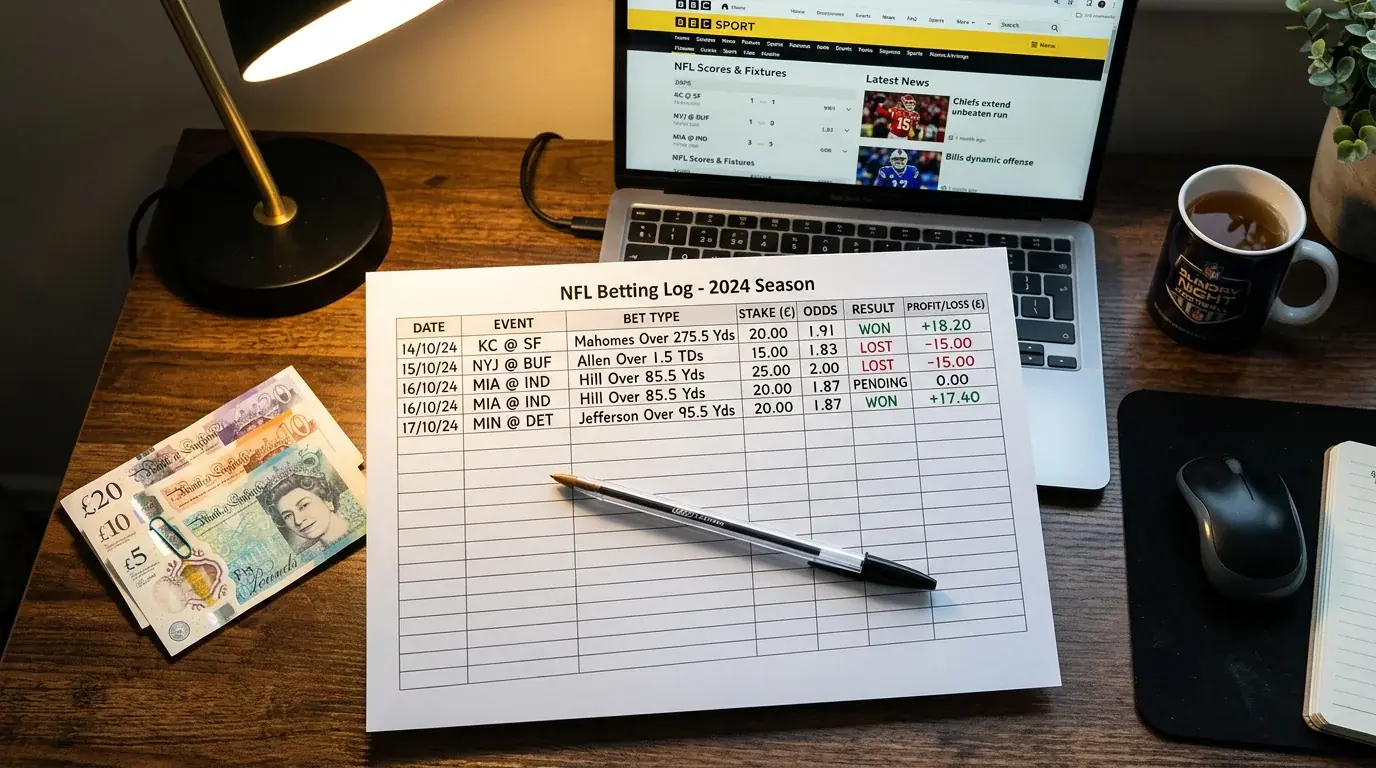
My tracking system is a spreadsheet with one row per bet. Each row records the date, the prop market, the line, the price, the stake, the result, and the profit or loss. At the end of each week, I calculate my rolling ROI (total profit divided by total stakes) and my rolling win rate. At the end of each month, I review the data for patterns — am I performing better on passing props than rushing props? Am I consistently overvaluing certain types of matchups? Am I staking too aggressively during losing streaks?
Rebalancing happens monthly. If my bankroll has grown by more than 20% from the starting level, I withdraw the excess and reset. If it has shrunk by more than 25%, I pause for a week, review my recent bets for systematic errors, and resume at a reduced stake. The pause is not superstitious — it is analytical. A 25% drawdown over a month might be variance, or it might indicate a flaw in my approach that only becomes visible in the aggregate. Taking a week to review before continuing prevents me from compounding errors that I have not yet identified.
The mechanical discipline of tracking and rebalancing connects naturally to the broader question of finding the best price across UK sportsbooks — line shopping is a bankroll-preservation tool as much as a profit-maximisation tool, because consistently better prices reduce the effective margin you pay and slow the rate of bankroll erosion during losing stretches.
What unit size is reasonable for NFL prop bets?
A unit of 1-2% of your total prop betting bankroll is reasonable for most UK punters. On a 500-pound bankroll, that means 5-10 pounds per bet. This stake feels small on individual bets but ensures your bankroll can absorb a 15-20 bet losing streak — which will happen multiple times per season — without being eliminated.
How should I adjust my stake after a losing week?
If you are using flat staking, do not adjust at all — the whole point is consistency. If you are using percentage staking, the adjustment is automatic: your stake shrinks because your bankroll has shrunk. Do not increase stakes after a losing week to recoup losses. That impulse is the single most destructive behaviour in sports betting and the fastest path to a depleted bankroll.
Is Kelly criterion realistic without a proper model?
Not in its pure form. Full Kelly requires a precise estimate of your edge, which is almost impossible in prop betting without a quantitative model. Fractional Kelly — quarter or half Kelly — is more practical because it tolerates imprecision in your edge estimates. Even without a model, the Kelly framework is useful as a discipline tool: it forces you to articulate your estimated probability before betting, which improves decision quality regardless of the staking formula you ultimately use.
Prepared by the Prop Bets for nfl editorial staff.