NFL Bet Builder UK: How the Single-Game Customiser Actually Works
 Available in US
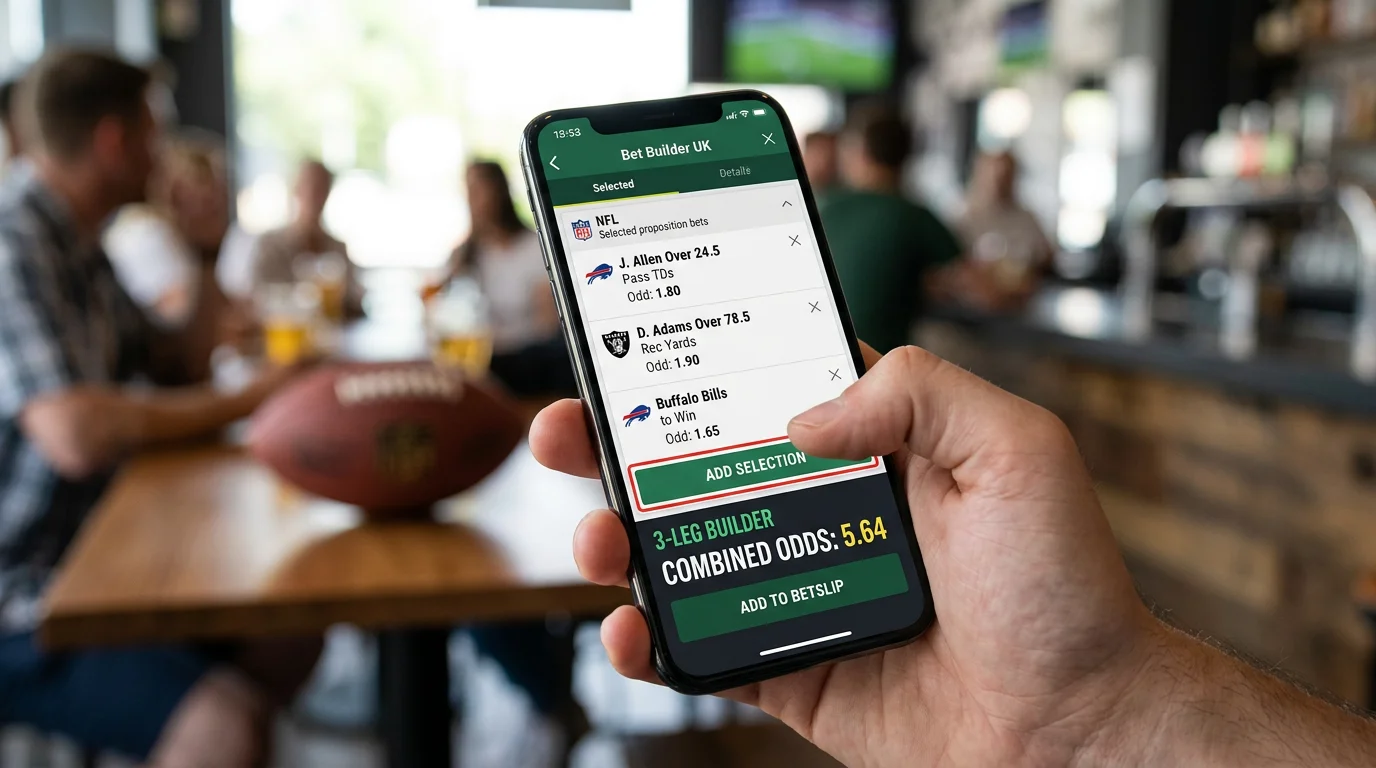
What a bet builder offers that a regular slip does not
The first time I used a bet builder for an NFL game, I combined a passing yards over, an anytime touchdown scorer, and a team total over into a single bet at 6.50. All three legs hit, and the payout felt like a revelation. The second time I used a bet builder, I combined five legs, none of which hit, and I lost the entire stake. That whiplash taught me the essential truth about bet builders: they are the most flexible tool in the UK sportsbook menu, and the most dangerous one for punters who confuse flexibility with opportunity.
A bet builder — called a same-game parlay at US sportsbooks — lets you combine multiple selections from the same fixture into a single wager. Before this feature existed, you could not combine two props from the same game because the outcomes were correlated (more on that shortly). The bet builder’s pricing engine accounts for those correlations and produces a single combined price that reflects the interdependence of your selections. Jeff Feazel of BetMGM has described how same-game parlays have continued to skyrocket in volume, and the UK market mirrors that trend — bet builders are now the fastest-growing product category at most major UK sportsbooks.
Discover everything about prop bets for nfl here.
Which prop markets are eligible
Not every market can be included in a bet builder, and the restrictions vary by sportsbook. The core eligible markets at most UK platforms include player props (passing, rushing, and receiving yards; touchdown scorers; receptions), game and team totals (over/under on game total, team totals, half totals), and match result (spread, moneyline). Some books also allow inclusion of quarter props, first scorer markets, and specific defensive props, but availability is inconsistent.
The reason certain markets are excluded is correlation management. The bet builder’s pricing engine needs to model the relationship between your selections, and it can only do that for markets where the correlation structure is well understood. A passing yards over and a team total over are positively correlated — the engine can price that. A “first player to score a rushing touchdown” and an “anytime rushing touchdown scorer” are nearly identical markets that would create a pricing paradox — the engine rejects them.
I have found that the most productive bet builder configurations use three to four legs drawn from different statistical categories. A passing yards over, a rushing yards over, and a team total over draws from three distinct performance dimensions while maintaining a coherent game thesis. Five or more legs drawn from overlapping categories (passing yards + passing TDs + completions) tend to produce prices that look attractive but embed redundant risk — if the game script turns against passing, all three legs fail simultaneously.
Building a balanced bet builder slip
Balance in a bet builder means constructing a slip where the legs are logically coherent but not so tightly correlated that one game-script outcome kills every selection. This is harder than it sounds, and most punters get it wrong by stacking legs that all depend on the same thing happening.
A bad bet builder: team to win, team total over 27.5, quarterback over 280.5 passing yards, wide receiver over 85.5 receiving yards, running back anytime touchdown scorer. Every leg of this slip depends on the team’s offence performing at a high level. If the team falls behind early and the game script shifts, the quarterback might throw enough to hit his yards line, but the running back loses his goal-line opportunities, the team total drops, and the wide receiver’s targets get spread across desperation routes. One adverse game-script shift sinks four of five legs.
A better bet builder: quarterback over 245.5 passing yards, opposing running back over 65.5 rushing yards, game total over 44.5. These three legs are positively correlated with a high-scoring game but draw from different teams and different statistical categories. A shootout benefits all three. A defensive struggle hurts all three. But a lopsided game — where one team dominates — can still produce a passing yards over for the trailing quarterback, a rushing yards over for the leading team’s back, and enough combined scoring to clear the game total. The legs are connected by game environment but not tethered to a single team’s performance.
How the builder prices multiple legs
The bet builder does not simply multiply the decimal odds of your individual selections. If it did, the combined price would be too generous, because it would treat each leg as independent when they are actually correlated. Instead, the engine applies a correlation adjustment that reduces the combined price to reflect the fact that the legs tend to move together.
The size of the correlation adjustment varies by the degree of dependency between your selections. Legs from the same team with strong positive correlation (passing yards over + team total over) receive a larger adjustment, producing a lower combined price. Legs from different teams or different statistical categories receive a smaller adjustment, producing a price closer to the naive multiplication.
In practice, the combined price on a three-leg bet builder is typically 10-25% lower than the product of the individual decimal odds. A slip with individual legs at 1.90, 1.85, and 1.95 would produce a naive combined price of 6.85 (1.90 x 1.85 x 1.95). The bet builder might price this at 5.50 to 6.00, with the reduction reflecting the correlation adjustment plus the book’s additional margin on the combined product. That additional margin is the fee you pay for the convenience of combining legs from the same game, and it is larger than most punters realise.
Differences between UK bet builder tools
Not all bet builders are built the same. The major UK sportsbooks use different pricing engines, different correlation models, and different eligible-market lists, which means the same three-leg combination can produce meaningfully different prices across platforms.
Check out our guide on Bankroll Management for NFL Prop Bets: Staking Plans That Survive Variance as well.
I tested this during the 2025 season by building the same three-leg NFL bet builder — a mainstream passing yards over, a rushing yards over, and a game total over — across four UK sportsbooks for every Sunday slate. The price variation averaged 12% between the best and worst book. On a slip priced at 5.50 at the best book, the worst book offered 4.85 for identical selections. That difference is the same magnitude as the price variation on individual props, which means line shopping for bet builders is just as important as line shopping for single bets.
Beyond price, the tools differ in user experience. Some books show the correlation adjustment transparently — you can see how each additional leg changes the combined price. Others show only the final price without decomposing the adjustment. Some books allow you to add and remove legs fluidly; others require you to rebuild from scratch if you want to change a single selection. The operational differences matter because they affect how quickly you can compare options and how confidently you can evaluate the combined price.
The pricing mechanics of bet builders connect directly to the concept of correlated prop bets — understanding which legs move together and which move independently is the foundation of building slips that offer genuine value rather than false convenience.
Can I include futures markets in a UK bet builder?
Generally no. Bet builders are designed for single-game markets — player props, team totals, and match results within the same fixture. Futures markets (season win totals, division winners, MVP) are priced on a different timeline and cannot be combined with game-day props in the same bet builder. Some books allow futures accumulators as a separate product, but these are not bet builders in the technical sense.
Why does the bet builder reject some of my prop combinations?
The bet builder rejects combinations where the correlation between selections is too strong for the pricing engine to model reliably. Common rejections include pairing a ‘first touchdown scorer’ with an ‘anytime touchdown scorer’ on the same player, or combining a player’s passing yards with their passing completions. The engine treats these as near-duplicate selections and blocks them to avoid pricing errors.
Are bet builder slips refundable if a player is a late scratch?
Settlement rules vary by sportsbook. Most UK books void the leg involving the inactive player and recalculate the bet builder as if that leg did not exist, reducing the combined price accordingly. Some books void the entire slip if any leg involves an inactive player. Check your sportsbook’s bet builder terms before placing — this is one of the most common sources of post-settlement disputes in NFL prop betting.
Published by the Prop Bets for nfl team.